Five Short Listening Labs to Learn Backyard Birdsong
Why practice listening to birds?
Recognizing bird songs is a practical, calming nature skill you can build with short, focused practice. You don’t need special gear: just a quiet corner of your yard or a nearby park, a little patience, and a notebook. These five mini-experiments are designed to be done in sequence. Each one takes 5–15 minutes and focuses your attention on a different musical element of birdsong—pitch, rhythm, repetition, phrase shape, and memory.
How to use these labs
Do one lab per day or repeat the same lab for several days until it feels familiar. Keep a simple log: date, location, weather, and one line describing what you heard. Over a few weeks you’ll notice patterns and begin to link sounds to birds you see or photos in field guides.
Lab 1 — Find the dominant sound (5–10 minutes)
Objective: Train your ear to pick out the loudest/most frequent bird sound in a short listening session.
- Sit quietly and set a timer for 5–10 minutes.
- Close your eyes for a minute to minimize visual distraction.
- When you hear a bird sound that repeats or stands out, note whether it is high, medium, or low pitch and whether it is a short chip or a longer warble.
- Write one sentence in your log describing the dominant sound (for example: “Repeated high tinkling notes, fast and bright”).
Lab 2 — Focus on rhythm and repetition (7–12 minutes)
Objective: Notice timing patterns—how often notes repeat and if there are clear pauses.
- Listen for a single species’ song or call and count how many notes in a typical phrase (e.g., “one-two-three” or “chip-chip”).
- Tap your finger in rhythm to a repeating phrase to internalize its pattern.
- Record the rhythm in your log using simple marks (| for pause, – for short note), for example: “tink-tink | tink-tink-tink”.
Lab 3 — Sketch the pitch contour (10–15 minutes)
Objective: Train your sense of rising and falling patterns in song phrases.
- Listen for a phrase that has a clear beginning and end.
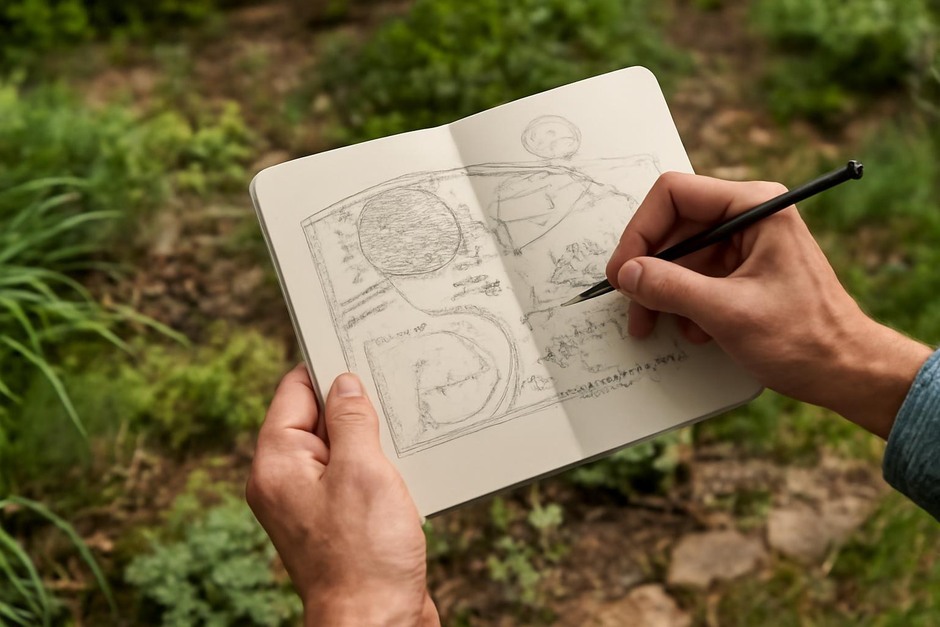
- On paper, draw a simple line that rises for higher notes and falls for lower notes—no musical skill needed, just a visual memory aid.
- Compare a couple of phrases: do they start high and fall, or start low and rise? Note this in your log.
Lab 4 — Match sound to sight (10–15 minutes)
Objective: Begin linking the sounds you hear with the birds you can see.
- After a listening period, gently scan the area for movement. Binoculars help but aren’t necessary.
- When you spot a bird that might be singing, observe its size, color, and behavior (bouncing on a branch, feeding, perched high).
- Write an entry: sound description + brief visual notes (e.g., “bright trills; small brown bird with white eyebrow perched on top branch”).
Lab 5 — Short memory test and review (10 minutes)
Objective: Strengthen recall so you can recognize songs later without hearing them first.
- Listen for 5 minutes and note the main song types heard.
- Afterwards, try to hum or whistle each song from memory; don’t worry about accuracy—focus on overall rhythm and pitch direction.
- Review previous log entries and try to match today’s sounds to past descriptions. Jot down any consistent matches.
A simple daily routine to keep improving
Try a 10-minute morning session: 2 minutes to settle, 5 minutes for one lab (rotate through Labs 1–5 across the week), and 3 minutes to log observations. Repeat the same lab for a few days when it feels useful—consistency beats intensity.
Next steps and gentle tips
- Be patient with yourself; recognition often grows slowly.
- Use your log to spot patterns: times of day when certain songs occur, or weather that changes activity.
- If you choose to use a field guide or app later, refer back to your notes to confirm identifications rather than relying solely on images.
These small listening labs are designed to be relaxing and repeatable. Over weeks you’ll build a useful ear for local birdsong and a quiet habit that brings the natural world closer to home.